
Specialty contact lenses for keratoconus and irregular corneas
We fit the eyes a standard lens cannot: keratoconus, corneal scarring, and eyes after a transplant or refractive surgery. Scleral lenses first, and an impression fitted lens when even those will not sit.
What keratoconus is
The normally round cornea thins and begins to bulge into a cone.
Keratoconus is a progressive eye disease in which the normally round cornea thins and begins to bulge into a cone-like shape. This cone shape deflects light as it enters the eye on its way to the light-sensitive retina, causing distorted vision.
Glasses and a standard soft lens both work with the surface the eye already has. A scleral lens does something different: it clears that surface entirely and gives the light a smooth one to enter through.
A lens that rests on the white of the eye
Large enough to vault the cornea completely, and to sit instead on the sclera, which is the white around it.
How the lens does it
- 01An oxygen permeable material, so the eye still breathes under it
- 02A large diameter, so the lens clears the cone rather than sitting on it
- 03A smooth artificial surface for light to enter the eye through
Despite their size, these lenses are comparable in comfort to most soft contact lenses.
Reasons to be fitted in a scleral lens
Keratoconus is one reason among several. The first thing to know is that these eyes are fitted here, by a doctor who does it every week.
- Best corrected visual acuity below 20/40 because of corneal irregularities
- Corneal scarring causing haloing or glare
- Keratoconus, a degenerative corneal disease
- Pellucid marginal degeneration
- After radial keratotomy, or RK, surgery
- Corneal irregularities after refractive surgery
- Ocular host versus graft disease
A scleral lens fitting is measured, not guessed. Corneal topography first, to map the shape of the cornea. Then a diagnostic lens on the eye, to find the best fit and the best vision. Then a lens ordered to your eye's own parameters. When it arrives you are taught to put it in and take it out, and seen again a week later to check the fit and the health of the eye.
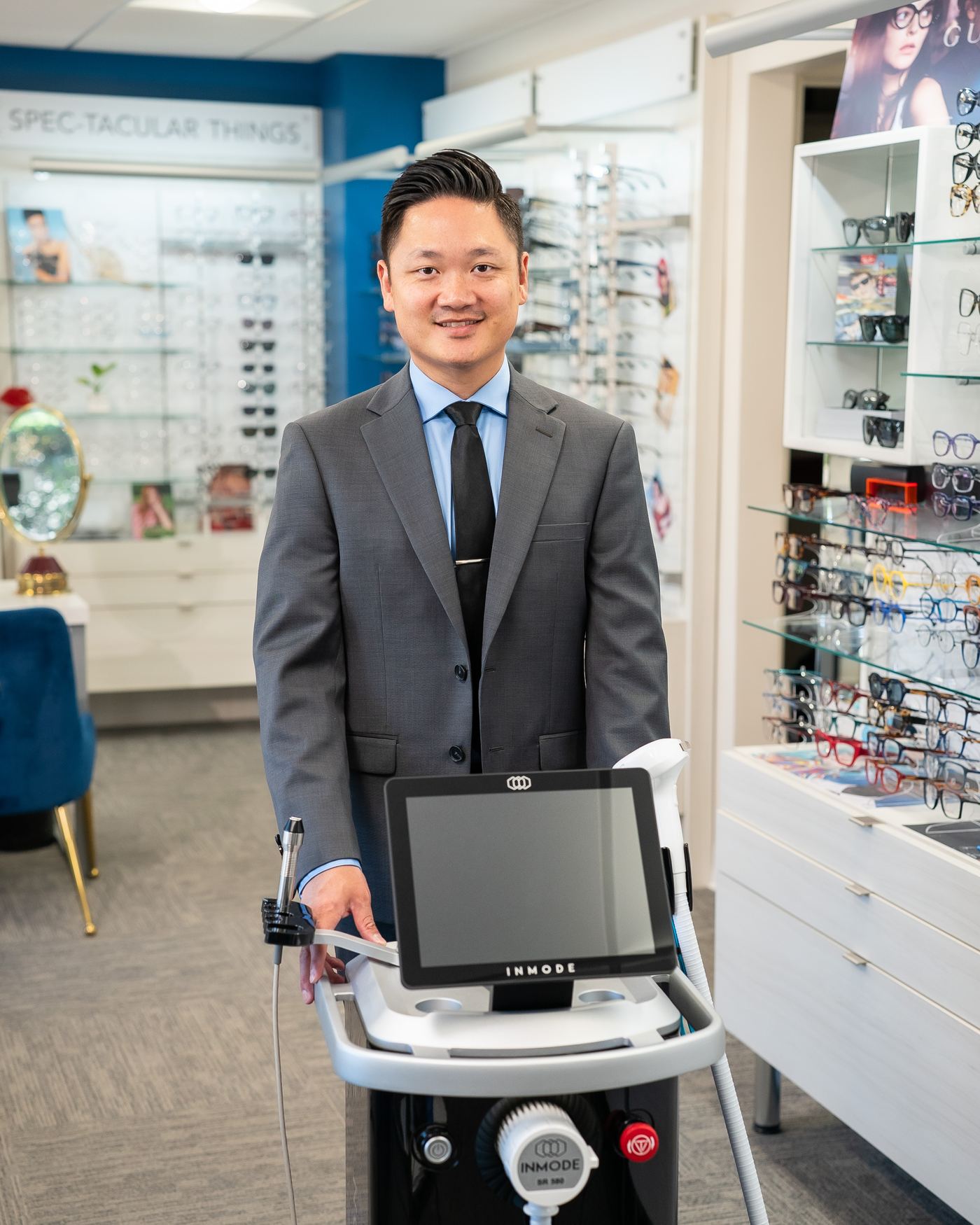
Dr. Long Nguyen fits specialty contact lenses for irregular corneas, including eyes that have had a corneal graft. Despite their size, these lenses are comparable in comfort to most soft contact lenses.
When a standard lens still will not fit
Some eyes are irregular enough that neither a conventional lens nor a standard scleral lens sits well on them. Those are made from an impression of the eye itself, and Dr. Nguyen is credentialed by EyePrint Prosthetics to take it here in Burbank.
 Captions on
Read the transcript
Hi, I'm Dr. Kumar. Today we'll be walking through the process of taking an ocular impression. The process of taking an ocular impression is a painless procedure that takes just minutes. We use an FDA approved ocular compound that is applied with a tray that fits perfectly into the eye. The impression captures all ocular surface irregularities and provides more information than traditional topographical mapping.
An important part of the process takes place before the patient even gets to the exam room. It's crucial that patients discontinue wear of their current contact lenses for a minimum of 48 hours before the impression procedure. We need the eye to resume its natural shape without any influence from a patient's past fit. The compound we use is able to capture the tiniest of details, so we want to avoid running into any artificial data. Think of it like the impression of a ring on your finger: it takes a few days for an indentation to completely disappear.
After an impression is taken, it's scanned into our patented software and hand designed by one of our [EyePrint] consultants. This data is then sent to a special laboratory where the custom device is fabricated. (Music.)
Okay sir, now tell me what you thought about the process. "Wow, it was a non-event. It was quick, it was really easy. It seems so very simple. The process didn't hurt at all. I didn't feel like my eyes were irritated at all. It basically was just a non-event." Wonderful. Now, if you had to pick maybe one thing that was uncomfortable or difficult about the procedure, what would you say? "Wow, nothing was really difficult about the procedure. If I had to say anything, I guess I would say trying to keep my eyes fixated on one focal point during the process of the test, for about a minute and a half, but that was not difficult by any way, shape or form. And the test was so much easier than the standard scleral lens fittings that I'd had before in the past. And I know I'm going to get a custom fit lens. It's going to perfectly fit my eye. I'm really excited about it."
Thank you for joining us. We hope this video has been informative for you. Feel free to contact our team for any further questions. (Music.)
 Captions on
Read the transcript
Millions of people suffer from debilitating conditions that impair their vision, requiring them to wear specialty or prosthetic lenses. Typically, when a doctor orders a specialty lens, the goal is to align standard lens curves with the shape of the eye. However, a contact lens naturally moves around on the eye, especially on highly irregular corneas. One slight rotation makes a big difference. Indeed, this type of lens fitting is not an exact science. It is an art that frequently requires many costly revisions, and some patients are never able to find a suitable lens.
The EyePrintPRO lens was designed to fit in an entirely different way. The EyePrintPRO is similar to a scleral lens insofar as it is made of the same FDA approved oxygen permeable materials, and the fit vaults the cornea while landing on the sclera. However, instead of using a series of curves, the EyePrintPRO is designed using patented elevation specific technology to exactly match the unique irregularities of each individual eye. It's also treated with Tangible Hydra-PEG to improve surface wettability, increase lubricity, and reduce protein and lipid deposition.
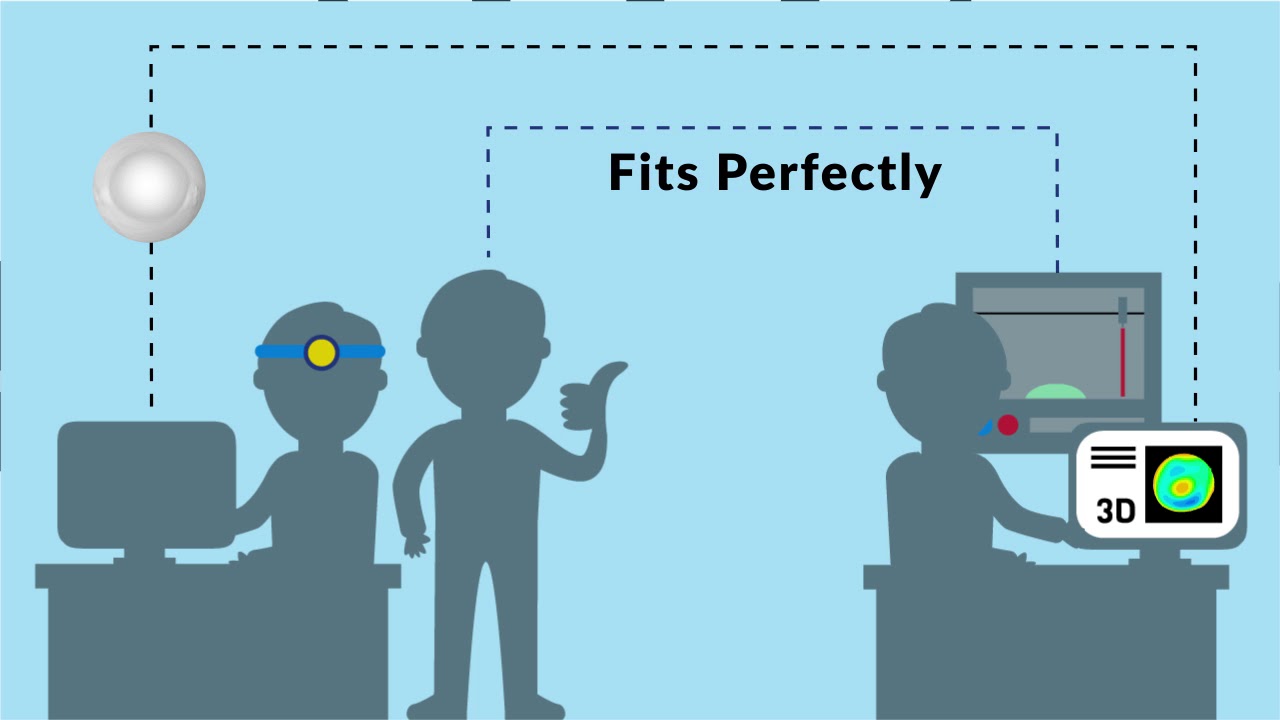
The EyePrint process begins with an EyePrint impression. Doctors then send the impression to an EyePrint lab for 3D scanning. The scanned data is then used to produce a lens that matches the impression exactly, and therefore fits perfectly. Because of the precise nature of the back surface fit, high quality and individualized optics can be placed on the front surface of the device. You can even order EyePrint lenses for irregular astigmatism. Better still, ordering records reveal that 95 percent of eyes are fit within two lenses.
Because the EyePrintPRO is not constrained to typical fabrication, these lenses can be made for even the most difficult conditions where other options have failed. EyePrint certified practitioners have successfully fit the lenses on patients with many types of irregular corneal conditions, including keratoconus, trauma, deformity, pellucid marginal degeneration, chemical burn, post LASIK, PRK or RK, corneal transplant, pinguecula, pterygium, severe dry eye, and after glaucoma surgery. To find out if an EyePrint lens can help you, visit eyeprintpro.com to locate a certified doctor in your area. (Music.)
EyePrint Prosthetics
An impression of the eye's unique surface is captured and used to create a customized lens design that more closely follows the individual contours of the eye.
EyeFitPRO
An impression based fitting process that captures the elevation and contours of the ocular surface, so the lens is designed around the actual anatomy of your eye rather than relying solely on standard measurements.
"Your eye is unique. Your lens should be too."
Scleral lens consultations are booked by phone
Online scheduling is for routine appointments. Please call the office to book medical appointments and contact lens checks.
Call the office and ask for a scleral lens consultation.